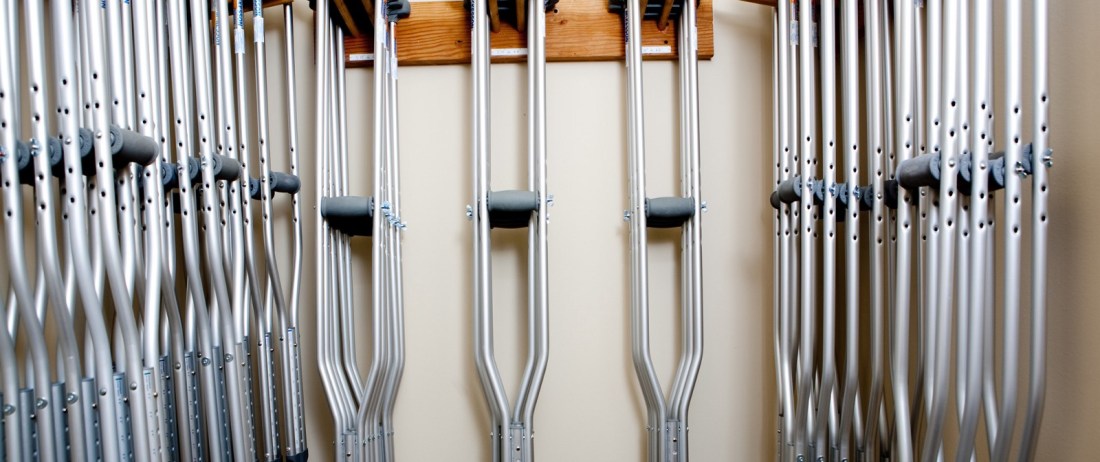
If I ever move to a new city, I’m packing a pair of crutches.
When I injured my knee in a misadventure in New Zealand a while back, I discovered that hobbling around is one of the best ways to meet people. Most of us don’t really think to reach out and help someone; we’re usually lost in our own thoughts and problems. Will certainly me. We certainly wouldn’t think to reach out and help someone who’s 6’4″ and looks like they’ve got it together.
On crutches, though, the equation is completely flipped. I found that everyone wanted to talk to me. Strangers came up and asked how I’m going, and how I injured myself, which is fascinating in itself. I also found that at work — the few times that I was actually able to hobble into the office, in the first couple of weeks — I suddenly had a very different relationship with my staff.
For example, when I normally meet with my engineering team, I’m somewhat of an imposing and intense figure. When I was injured, though, they were hurrying around to get me a chair, a cushion, to make sure that was comfortable. I found the act of someone getting me a chair a quite strange and humbling experience. I kept thinking: “That’s usually my role!”
As a natural consequence, I became more respectful of the people around me. When I’m at full health, I feel like I can do it all myself, so I can be quite dismissive of others help. But when being quite conscious of people being attentive to me, I felt much more appreciative of the humanness of others. That’s the attitude I’d like to have in a foreign city. On crutches, obviously physically disabled, it’s an easy invite for people to offer to do something for you, or to take care of you.
Even travelling the 150 metres or so between the office and a favourite café became a mission. Getting there wasn’t so bad, because it’s mostly downhill, but on the way back, I have to grit my teeth while thinking, “I feel so incompetent!”
An interaction at that café sticks out in my mind. There’s a Canadian waitress who’s served me at least a hundred times, yet we had never learned each others’ names. As soon as I hobbled in there, though, she asked what caused my injury, and what I was doing to treat it. That led us into a whole conversation on the reason why she’s here in Australia: she’s doing rehab masseuse work for an amateur AFL club.
As I was leaving, she gave me some specific advice on how I should treat my knee, and how I should let the Arnica tablets dissolve under my tongue rather than swallowing them. I could tell that she really cared that I was injured. It was quite humbling, because normally when I walk in there, I’m quite self-absorbed. Not in a rude way, but because I’m thinking through problems, or working on my laptop. Now we know each others’ names, and there’s a whole level of human connection created simply because she was caring for my wellbeing, even though she had no cause or reason to. Just the fact that she could see I was in pain was enough for her.
I pride myself on being relatively indestructible. I like to think I’m fairly resilient. I can work through most barriers: pain, sleep, stress, whatever’s thrown my way. So to be in a situation where I feel like I’m the most vulnerable of the group is really uncomfortable.
The injury affected every aspect of my life, not least how I do my job. It forced me to be more patient — certainly a good thing. Even being out of the office allowed me to respond to situations much more calmly. Because I felt incapacitated, I didn’t have the same level of ‘go’ that I normally did, so I could just work through problems that might’ve affected me differently, were I not injured. There was a lot more questioning and considered thought on my part.
I wouldn’t say that I’d want to be in this state all the time, but I definitely found silver linings in that cloud.

 Simon Kalinowski